Contents
中文版:使用Anki高效学习语言 – Frank’s Weblog
As mentioned earlier, I learned French from scratch and achieved CLB/NCLC 7 (equivalent to CEFR B2-C1) within 10 months. This was a challenging goal, and I believe Anki played a pivotal role in my success. As for why learning French, please read: Say Goodbye to H1B Anxiety – A Complete Guide for Immigration to Canada via Express Entry – Frank’s Weblog
I didn’t take any traditional courses throughout my entire language learning journey. At the beginning, I followed the A1 and A2 online courses from NLF Academy | Real French Classes – YouTube, using the Edito textbook. I spent two months to complete A1. Later, due to time constraints, halfway through A2, I stopped taking the courses and switched to self-study and exam preparation. During this process, I intensively used Anki to learn grammar, vocabulary, expressions. The results were remarkable.
This post outlines how I utilized Anki for both exam preparation and hobbyist language learning.
Background
Many people think Anki is just a tool for memorizing vocabulary. However, Anki is far more than just for memorizing words. Anki is a Spaced Repetition System (SRS) that uses the Ebbinghaus forgetting curve to help you review each note, effectively preventing you from forgetting older material as you learn new things. Additionally, Anki supports various card types and various media formats. Anything that can be written in HTML can be put into Anki. Anki is not limited to learning. Anything you think needs to be memorized can be put into Anki.
Some of you may have heard of Chinese singer Shang Wenjie’s language learning method. The method involves downloading 20-minute audio segments, for example, from RFI, painstakingly transcribing them word-for-word, and then memorizing the text you can recite it at the original speed.
Of course, this learning method is controversial and not realistic for most people. But I believe its underlying principle is correct: In my opinion, the core of foreign language learning lies in continuously learning new material(words, grammar, etc.) while repeatedly reinforcing what has already been learned to form “muscle memory”.
Anki, as a memory tool, can make this process more efficient and less burdensome. Repetitive training is a very tedious process, and Anki can turn this into a part of daily life, thereby reducing the friction. This is actually very similar to Duolingo’s philosophy.
Getting Started with Anki
Anki is free software, and all its software, including the cloud service, is open source and free, with the only exception being the iOS app which costs $24.99. According to the developers, revenue from the iOS app funds the free AnkiWeb cloud service. Although this price is relatively high for a mobile app, I think it’s well worth the investment.
Anki has a steep learning curve, and due to its flexibility, different people will develop their own usage methods. This article discusses several tips for using Anki, which I think are highly effective: My Method and Insights on Learning French with Anki | by 貓肆 | Medium
Usage
Memorizing Vocabulary, Phrases, Sentence Patterns, Grammar
Memorizing vocabulary is essential in language learning. I put unfamiliar words encountered during learning, along with their audio, into Anki. Using Basic (and reverse) cards allows for bidirectional word-to-meaning and meaning-to-word review. The meaning can be in Chinese or English, whichever offers a clearer definition.
However, mastering a language involves far more than just vocabulary: there are also phrases, sentences, or grammar knowledge, etc. French grammar involves many nuances, such as spelling, particularly those with accents, gender, and conjugations. These things don’t always follow rules, so often they still need to be memorized.
These words or knowledge can be obtained from anywhere, such as textbooks, courses, YouTube videos, news, exam questions, etc.
Pronunciation
I believe incorporating audio into the learning process is crucial. I use Narakeet, a Text-To-Speech service. It is a paid service but is quite affordable. I wrote a Python script to batch generate pronunciations via API and add them to Anki. Since I only began adding pronunciations halfway through my studies, some cards are missing pronunciations. If I encounter cards that need correction during learning, I flag them and fix them in batches on weekends.
My Python script is here: https://gist.github.com/frankgx97/a9516c9f612631a0469a7e61ec2b0812
If your card content is relatively simple and regular, you can also use the HyperTTS plugin to add voices in bulk, but I think the voice quality of free services is not as good as Narakeet.
Each review looks like this:
Memorizing Gender
Mastering French grammatical gender can be a real struggle. Since I didn’t establish a strong foundation early on, I often got the gender of words wrong, but language accuracy is very important in the written component. French genders have some rules, but in practice, you can’t rely entirely on rules. I created a separate deck for nouns or common noun suffixes using “type-in” cards and review them daily.
Practice Writing and Speaking
Writing is notoriously challenging. While templates can simplify the process, the primary difficulty lies in the TCF’s requirements for accuracy. For learners under time pressure, writing often reveals weak grammatical foundations. If your vocabulary and phrasing are good but lack accuracy, the most common outcome is getting stuck at 9 (just below B2).
Initially my preparation for writing was simple: write, then have ChatGPT score it. After the first exam, I got 9 points.
Afterward, I reviewed my writing. I think the biggest problem was grammar and accuracy. For example: I wrote “la clé” as “le clê” in the exam. There might be many similar mistakes that I didn’t notice. I took the following measures and successfully improved my writing from 9 to 13 points(solid B2) in the second attempt in one and a half months, and maintained 13 points in the third exam.
- Create your own templates and ensure they are adaptable to various topics. Make sure you can start writing after reading the question, reducing cognitive load in the exam.
- After having the template reviewed by a native speaker and/or AI, in daily practice, time yourself according to the template, then only ask AI tools to find grammatical errors, no need for scoring content or suggesting modifications. The goal is to minimize grammatical errors under five per essay.
- Add any phrases containing errors to Anki using ‘type-in’ cards and review them daily.
- In the exam, strictly follow the template, strictly limit the word count and stick to simple and safe sentence structures. If I was unsure about an expression, I wouldn’t use it. Avoid showing off and going off-script.
Using templates has its limitations, from my personal experience, the score may be hard to exceed B2 level (13). However, if you can make minimum grammar mistakes, CLB7 is almost guaranteed.
Similarly, this method can also be used for training speaking.
Intensive Listening
Listening training is also very important. I used the famous <Compréhension orale> textbook. I skipped the course content, and only played the audio and did dictée, one leçon per day. In this process, I select some sentences that are hard to understand or worth memorizing, use Audacity software to extract the audio of just the sentence and put it into Anki.
Practicing Reading and Listening
Practicing exam questions is an essential part of preparing for TCF listening and reading. Because of my intensive learning style, when I started preparing, my proficiency wasn’t yet high enough to tackle real exam questions, so it was a real struggle at the beginning. I not only needed to practice the questions but also treat the questions as materials to learn.
I usually do the following:
- Simulate the real exam conditions when working on the questions, try to complete as many questions as possible. For listening, time the whole set instead of individual questions.
- Check answers, understand them as much as possible.
- Use a translator or AI to translate the text, understand the content.
- Put new words or grammar into Anki for later review.
- If you still don’t understand the answer, screenshot and ask AI, ChatGPT is accurate in most cases.
Listening transcripts are essential. If the website you use for practice doesn’t provide transcripts, you can buy them on Taobao(淘宝), Xianyu(闲鱼), or other online marketplaces. You can also use tools like AWS Transcribe to generate the transcripts yourself. Transcribing all Réussir audio with AWS Transcribe costs about $30.
This method is very grueling at the start because understanding one reading set takes almost a whole day. But later, consistency leads to a breakthrough, and the process gets faster and easier to manage. In the later stage, I basically stopped practicing full reading sets, just using Anki to review and keep my skills sharp. This allowed me to free up time to tackle listening and speaking/writing.
One pain point is that some questions in TCF reading are too abstract, and many answers are controversial. This may just be the French way. Since TCF is a niche exam, it might not be as rigorous as TOEFL or IELTS. As candidates, we have few alternatives: either grind practice questions and rely on rote memorization, or just rely on luck.
Statistics
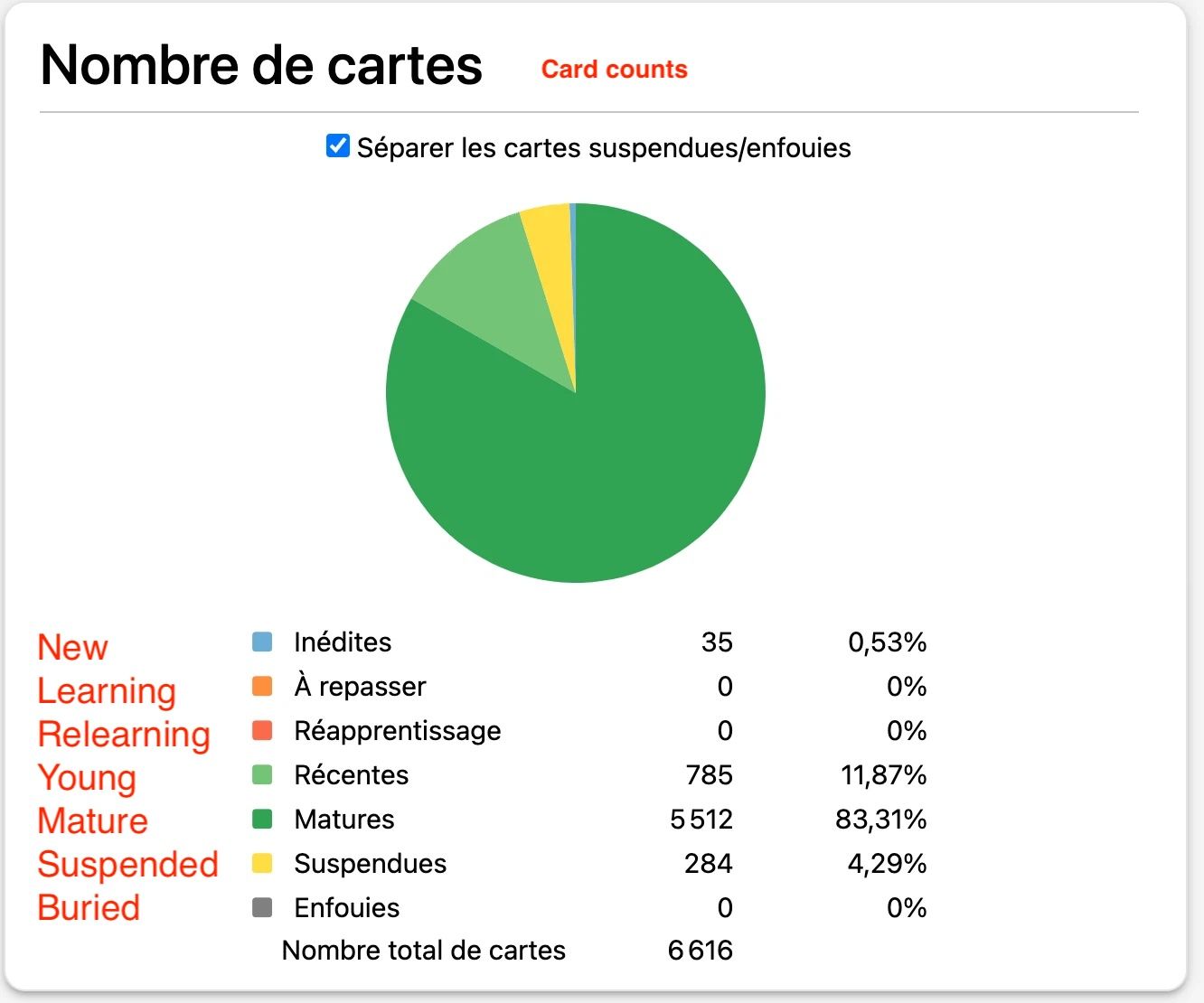
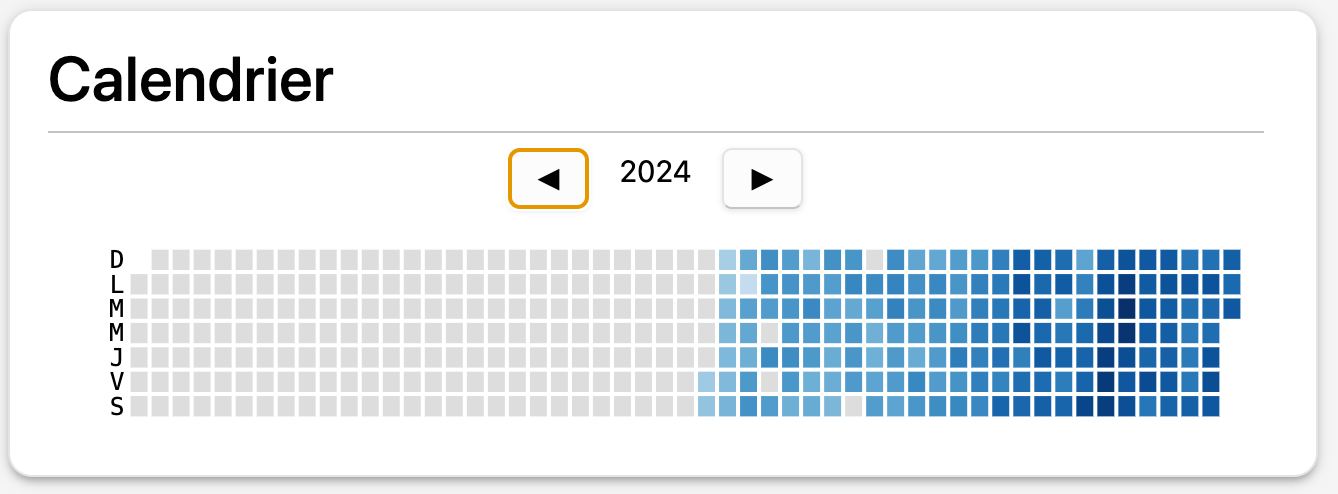
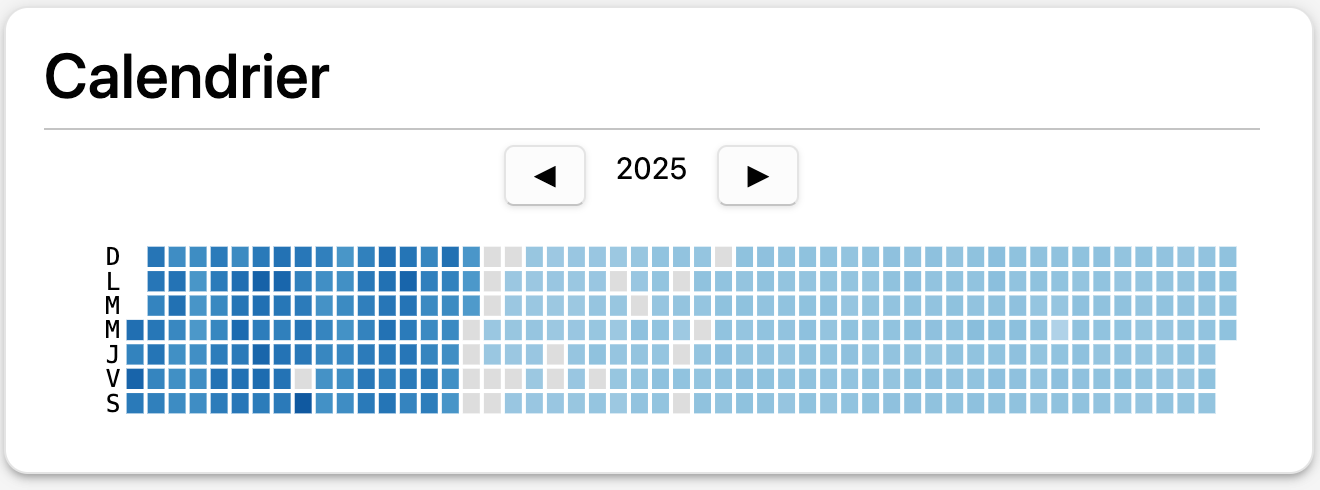
After establishing this process, the only thing needed is persistence. From starting to use Anki for learning on July 12, 2024, to receiving CLB7 scores on April 22, 2025, I consistently completed daily review tasks every day, with only 5 missed days. After passing the exam, I set the daily review limit to 35 cards to maintain French proficiency without degradation.
Workload
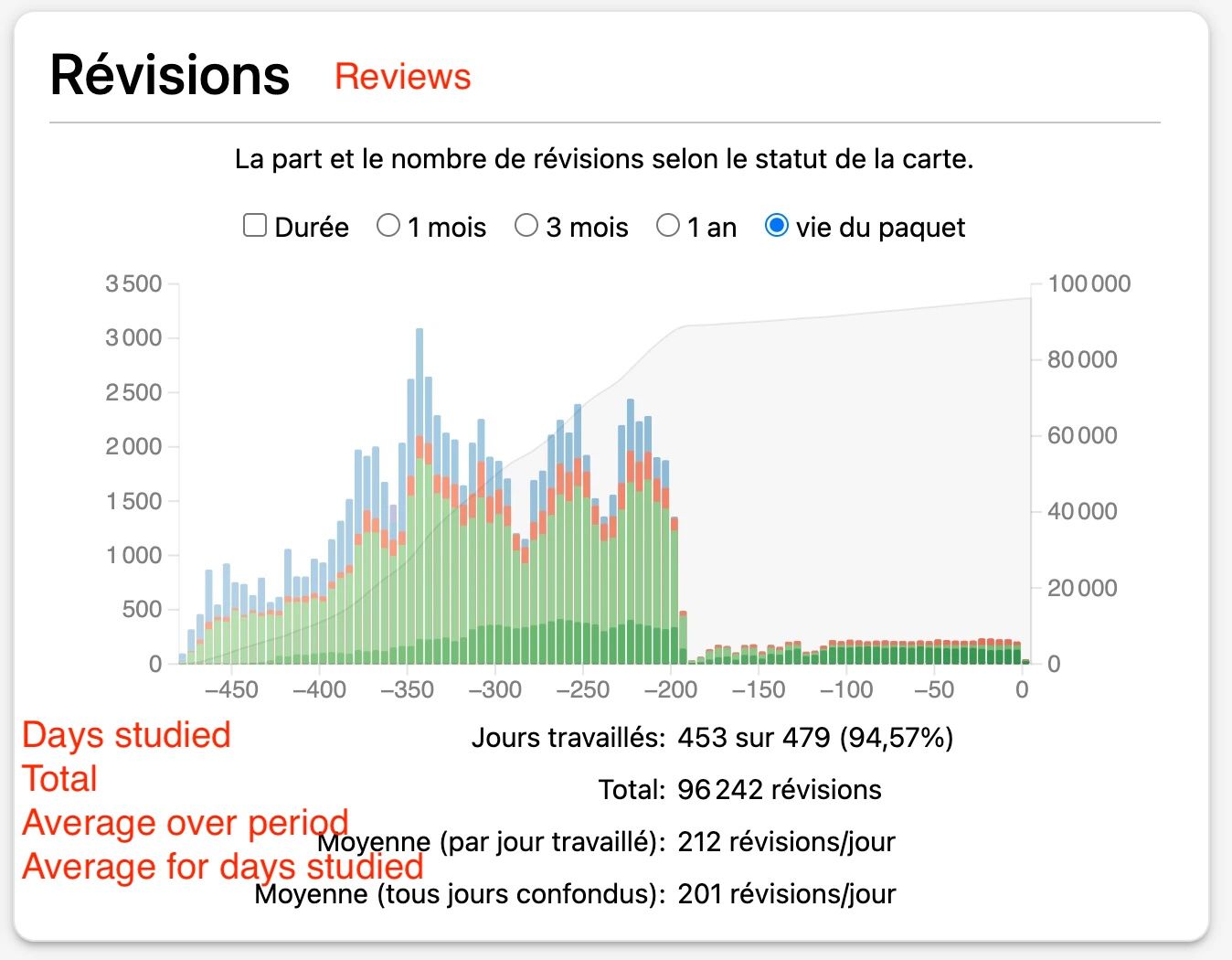
The following chart shows the daily workload, each bar representing about 5 days. Due to the time pressure of exam preparation, I didn’t set a daily workload limit during learning, which caused cards to accumulate overtime, often requiring over an hour to complete daily review tasks. However, there is a limit that how much new material one can effectively absorb in a day, so reasonably managing workload and setting limits is necessary.
Learning Japanese for Hobby
We have seen how effective Anki can be for high-pressure exam preparation where efficiency is the priority. However, the underlying logic of Anki is universal. It is not just a tool for conquering exams, it is also for long-term accumulation. I will use my Japanese learning journey as an example to demonstrate how to adapt this same methodology to a hobbyist learning.
Linguist Stephen Krashen’s theory suggests that “comprehensible input” is the core of language learning. Its logic is: We don’t learn languages through deliberate practice of speaking, but acquire them subconsciously through understanding.
Learning for a hobby and learning for exams are fundamentally different: learning as a hobby usually involves consuming a lot of audio or text input, but lacks a grammar and vocabulary foundation to turn the input into language skills. Additionally, the difficulty of the content may not match the learner’s current language skill, and causes difficulty in learning.
For example, I’ve been listening to Japanese songs and watching Japanese TV series for about ten years, but I’ve never studied beyond the most basic grammar and vocabulary. So when reading Japanese, I can roughly guess the topic from kanji and intuition, but can’t understand the specific meaning. I can’t understand spoken Japanese at all, and I don’t even know how to read many common kanji.
To address this, my approach is to select appropriate learning material, then extract the vocabulary and grammar from it and put them into Anki. This process can be assisted by AI tools. The learning material I use is lyrics, but you can choose TV, movies, novels, news, etc., based on your preferences. Ideally, your Anki cards should include rich context. The goal is to immediately associate a word or grammar point with a specific line from a song or a scene from a movie. Once everyday audio or text input can be understood, the snowball can start rolling and grow bigger.
Exam preparation usually has time pressure, so it needs to be treated as a “task” to complete. But learning as a hobby has no such pressure. Systematic learning typically follows a gradual difficulty curve. In contrast, hobbyist learners often encounter content far beyond their current skill level, which frequently leads to frustration and abandonment of the language. Therefore, compared to the quantity and difficulty of learning, it’s more important to focus on how to make the learning process sustainable.

发表回复/Leave a Reply